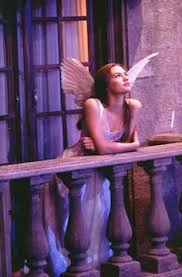
I was debating a professor of Shakespeare about the merits of Romeo being the villain and whether Shakespeare himself believed him as such. Let’s say that I was unsuccessful in turning him to the dark side. But my other soap box is just as juicy…
Romeo and Juliet is not a love story.
I think this is fairly obvious in that it is a tragedy. Love stories can end sad, sure. But Romeo and Juliet goes well out of its way to show Romeo as a flaky and fickle young man when it comes to love. And Juliet is chasing something else besides love in the play.
Romeo and Juliet is a heist!
That right, the play is a heist story. Juliet is our mastermind. The target is her very own marriage, which she intends to steal for herself. Romeo is either an unwitting accomplice or the mark. The nurse and friar are co-conspirators.
Juliet has a super big problem. She is going to be married off to Paris, who she has no interest in or intention of marrying. Her father wishes for Paris to get her consent, but he isn’t going take no for an answer. Juliet is stuck, but when Romeo shows up at her window professing his love, she comes up with a plan to steal that very marriage away from Paris and her father’s promises.
Religion is the Crux
One important aspect to note is that Juliet is extremely religious. She believes that a marriage made in front of God’s servants is binding and cannot be broken by man. She sets the plan in motion. Romeo is willing to get married, and Juliet should have been a wee bit skeptical of a man willing to marry someone he just met.
Still, she marries him, and then Romeo immediately messes her entire heist up by killing Tybalt. Now Juliet must make the best out of her situation before anyone finds out of her marrying the villain. Romeo is still her husband, no matter what a screw up he’s reveled to be, so she makes a plan to run away with him, even though her parents are sending assassins after him.
The marriage is still on, but she believes marrying Paris while being married to Romeo is a sin against God. She is running out of options and time. When the Friar suggest she take a poison to fake her death, so agrees. A simple solution to running away, but when she wakes to find Romeo dead, she makes a rash and terrible decision to end her own life instead of dealing with the alternatives, which the Friar told her was a nunnery or worse.
Ninth graders in the United States are often assigned Romeo and Juliet in English class, but many probably do not read it thoroughly, and most don’t understand it. Shakespeare was not giving us his tale of star-crossed lovers as a status symbol of love, but a tragedy of consequences. The lie the mainstream consciousness tells us is that Romeo and Juliet is the greatest love story ever told, but that misinterpretation fails the ninth graders and the rest of us. Indeed, Shakespeare’s play makes the opposite point, putting Romeo firmly in the seat of the big bad, or dare I say, the mustache-twirling VILLAIN!
“How is it possible?” you might say. Leonardo DiCaprio played the character in the 1996 version of the film! Yes, yes. Romeo is our dear, charming protagonist. But protagonists can be villains and are perhaps more memorable because of it. Famous villain protagonists include our favorite Scottish general, Macbeth, Walter White from Breaking Bad, and Julianne “Jules” Potter from My Best Friend’s Wedding (yes, Julia Roberts played a villain in a RomCom).
Villain is a social construct—a bad or evil person. Protagonists and Antagonists are story devices, opposing forces attempting to gain something in a story, but neither can attain it at the same time. But, but, but Romeo isn’t a black-hat-wearing evil doer, you might be saying, and there you would be wrong, again. But, like LaVar Burton with a book suggestion, you don’t have to take my word for it. We’ll go right to the source. Yes, to William Shakespeare himself—to the text.
Where shall we dine?
In a seemingly throwaway line, Romeo asks his friend which of their many options they could eat at. But this is Shakespeare we’re talking about and this is Romeo’s big introduction. Imagine for a moment, you are a groundling crowded into The Yard of the Globe theater. You paid a penny to get in, a penny that should have paid for that night’s dinner, but you chose to go there instead, to see what all the hype was about. A little hunger was worth getting a chance to see the new hotness.
Out strolls Romeo, half the play’s namesake, and like Robert Downey Jr. in his early 80’s douchebag roles, he spouts off an infamous line, “Where shall we dine?” A subtle hint to the groundlings that Romeo isn’t their hero, but a spoiled, rich kid with a lot of power to trample people like them. Also, Shakespeare uses the word “Villain” 17 times in Romeo and Juliet. What’s in a name? Upon inspection, 14 of those instances are directed at or reference Romeo, several of them coming from Juliet herself. What’s in a name indeed.
All the Single Ladies
Benvolio: Then [Rosaline] hath sworn that she will still live chaste? Romeo: She hath, and in that sparing makes huge waste
We begin our tale in Verona with a rich privileged boy of noble birth lamenting that the love of his short life, Rosaline, won’t have sex with him, calling her chastity a waste. The first two acts of our play are, indeed, about Romeo getting laid, at which he is ultimately successful. Here is a list of the villainous things Romeo does during this chase:
Sneaks into Capulet’s party to compare Rosaline against/ogle all the single ladies, which also happens to be Rosaline’s new theme song: Single Ladies (Put a ring on it) by Beyonce. Finds perhaps the youngest, and most desperate, girl (and cousin of Rosalin) to make out with, kissing her within moments of their first interaction, which is likely more a modern consent issue but is still creepy in context (more on Juliet later).
Upon learning Juliet is a Capulet, he still doesn’t give up, even though pursuing her will likely get them both into trouble (trouble being relative in a feud between families that often ends with people dying) Sneaks back (breaks) into the Capulet’s home after the party, hopping a wall (you know, normal hero stuff)
Peeps into Juliet’s bedroom like a creeper (she’s 13) Spies on Juliet, and perhaps worst of all, uses her words he overhears against her, to seduce her Quotes? You want quotes. I got ya quotes right here:
Goal 1: The hot list
Benvolio: Go thither, and with unattainted eye Compare her face with some that I shall show And I will make thee think thy swan a crow. Romeo: I’ll go along, no such sight to be shown, But to rejoice in splendor of mine own.
Goal 2: Stolen kiss
Romeo: O then, dear saint, let lips do what hands do. They pray: grant thou, lest faith turn to despair. Juliet Saints do not move, though grant for prayers’ sake. Romeo: Them move not while my prayer’s effect I take. [he kisses her]
Goal 3: Breaking and Entering
Benvolio: He ran this way and leapt this orchard wall.
Goal 4: The Peeping
Romeo: O, speak again, bright angel, for thou art As glorious to this night, being o’er my head, Romeo: Shall I hear more, or shall I speak at this?
Goal 5: The Weaponizing of Words
Romeo: My name, dear saint, is hateful to myself Because it is an enemy to thee. Had I it written, I would tear the word.
Ah, young love. Girl asks how the boy got so close to her bedroom, and he spouts poetry, saying love brought him there. Thirteen-year-old finds eighteen-year-old boy charming. Sure, they kissed a few times at the party, but Juliet starts talking about marriage. Romeo is ok with that for some reason and does not question it.
Perhaps, you’ll excuse these two love birds for their horniness—love at first sight bullshit. Do Romeo’s actions in the first two acts actually make him a villain? Perhaps, but alas, we still have three acts to go. Juliet Concocts a Plan
Like any great mastermind, Juliet uses any resource at her disposal to pull off the grand heist. Whoa, pivot much, you may be thinking, but here me out. This leads right into my next point about Romeo. Again, context is everything, and what is Juliet stealing? Her marriage and perhaps her life. Her parents had promised her to Paris, a far older, but culturally appropriate and safe husband for her. Juliet is trapped, until a dumb, but handsome boy shows up out of nowhere and starts kissing her at a party. The fleeting moment ends and she finds out he’s Montague, two setbacks. But then he shows up at her window professing his love for her. He doesn’t even balk at getting married. Could you imagine that scene playing out in a modern teenage comedy?
Dude: “You’re so hot. I love you.” Girl: “Great. Wanna get married? Like, could you get a priest and come back tomorrow?” Dude: “Um. Sure. That sounds awesome.”
But what about all that feud nonsense? Here is the plan and the tragedy of the play: Juliet and Romeo plan to secretly get married, consummate the marriage, and afterwards make a grand announcement to their families, perhaps fusing and healing their families’ feud as the lovebirds cling to each other, forcing the issue of reconciliation. Juliet wouldn’t have to marry Paris, or some other aging gross dude. Romeo would get his nookie. And Verona just might have their two great families finally getting along.
Of course, Romeo had to immediately ruin everything.
Bandying in Verona Streets
With Juliet’s plan in place and nookie acquired, Romeo strolls out into the streets, happily lollygagging like a well-fed puppy. Tybalt finds him, and is still angry about Romeo crashing the party and probably for kissing on his 13-year-old cousin. Romeo sticks to the plan for half a minute saying:
“I do protest, I never injured thee, But love thee better than thou canst devise, Till thou shalt know the reason of my love:”
Yes, a smarmy thing to say to a guy who wants to stab you. Mercutio decides to fight Tybalt in Romeo’s place, and Romeo does his best to try to get them to stop, even to the point of jumping in the middle of the sword fight. He ends up stopping the fight by giving Tybalt a chance to strike under Romeo’s arm, sealing Mercutio’s fate.
All good protagonists have a moment where they get to choose: will they choose the better path or will they follow the path that leads to the dark side, to hate and suffering. Ever the hothead, Romeo in his anguish, throws Juliet’s grand plan and Juliet herself under the bus, the proverbial bus headed toward vengeance town. Juliet will either be married to an outlaw or will become a widow. Decision made. Time to act.
Romeo, had he taken a step back, might have noticed this moment could play out with Tybalt getting arrested and tried for murder as the fight was in front of a lot of witnesses (“We talk here in the public haunt of men:”). Tybalt wasn’t getting away with killing Mercutio, and Romeo could show he was trying to make peace with the Capulets, hoping to stop it from happening. If Juliet had been there, perhaps she could have reasoned with him, gave him a few of those kisses he had been stealing, and the plan could have still played out in their favor, perhaps even more so
O, I am fortune’s fool!
Romeo knows killing Tybalt would have consequences, perhaps even making Juliet a widow, but alas, Romeo flies into a bout of rage, even though his friend’s death was a little his fault for getting in the way, and he cuts Tybalt, and all remaining of his 9-lives, down. The consequences are thus:
The feud between the Montagues and Capulets is hotter than ever.
Romeo had to flee Verona for a couple of reasons: to avoid arrest by the prince and retaliation by the Capulets.
Since he was not arrested and able to be tried, Romeo was banished from Verona
Juliet was left behind, still engaged to Paris without an obvious way out, with a new looming wedding date a few days away.
Juliet, when the truth came out, would be seen as impure and perhaps unmarriable—fate of Ophelia anyone? A nunnery or worse, floating down the river.
O that deceit should dwell In such a gorgeous palace!
Romeo’s actions thus far in the play have driven the plot forward, into ruin. His actions were selfish, vengeful, lustful, criminal, and murderous. Perhaps Juliet could still find a way out of the mess he’d created. But she’d married the villain:
Juliet: Shall I speak ill of him that is my husband? Ah, poor my lord, what tongue shall smooth thy name, When I, thy three-hours wife, have mangled it? But, wherefore, villain, didst thou kill my cousin?
From her youthful vantagepoint, her only course, now, was to leap off the “battlements of yonder tower” or to flee with Romeo, a man she’d married she’s just met (where was Elsa?) and join in his banishment. Romeo’s plan was just to skewer himself on his sword, but the Friar steps in there as well.
Friar Laurence: Hold thy desperate hand: Art thou a man? thy form cries out thou art: Thy tears are womanish; thy wild acts denote The unreasonable fury of a beast:
[An aside about Shakespeare: In the text, our dear poet often describes weakness and emotion as “womanish” yet shows the women being smarter and better decision makers, more apt to deal with situations when the shit hits the fan. What did Shakespeare believe? Was he just playing to the audience of his time, or did he buy into his own irony?]
So, even before our fateful self-stabbing moment, these two newlyweds were ready to end their own lives, not because of heartbreak, but because they had wrecked their pretty, privileged lives and didn’t want to live with the shitty consequences. Ah, youth.
With a looming wedding date, Juliet, instead of confessing her wedding to Romeo, agrees to the Friar’s ill-timed escape plan, one Romeo never hears about.
Once he learns Juliet is dead, yet again Romeo’s choices are limited, knowing the truth about their marriage will come out. The Nurse and the Friar are both complicit and will likely reveal their secret. This will reinforce his villainy in the Capulets’ sorrowed eyes. The Prince will likely upgrade his banishment to a death sentence. And Juliet’s mother was already planning his assassination:
Lady Capulet: We will have vengeance for it, fear thou not: Then weep no more. I’ll send to one in Mantua, Where that same banish’d runagate doth live, Shall give him such an unaccustom’d dram, That he shall soon keep Tybalt company: And then, I hope, thou wilt be satisfied.
Romeo knows he has forfeited his privileged life. Without his dear Verona and his backup, Juliet, his youthful imagination sees nothing ahead but misery, so back to the sword plan he turns, but not before visiting Juliet’s grave and committing one more act of villainy. Paris, who is mourning his fiancée’s death, finds the “haughty Montague” who had murdered Juliet’s cousin, “which grief, it is supposed, the fair creature died.”
Romeo kills him, too, further cementing his future fate to imprisonment or death, or a life on the run. Romeo takes the coward’s path, and kills himself, not because of love or a broken heart, not because of Juliet, but because in the end, he is nothing but a villain in his own story with nowhere to turn. Juliet, upon waking up and finding Romeo dead, has now lost her only escape from the consequences of their actions. She could confess, and who would put fault upon a 13-year-old girl in this situation. She might end up in a nunnery, like the Friar suggests, or married off to a less-than-ideal situation, but she would likely be seen as the victim. Her life would have gone on, but Juliet, seeing few options, decides to take Romeo’s path instead.
Poor sacrifices of our enmity!
The tragedy of Romeo and Juliet is not a loss of love, but a loss of life. Two stupid kids tried to outwit their fate, but instead of mending a feud with their marriage, they mended the feud with their deaths, all because of Romeo’s impulsive and damning actions.
Romeo wasn’t the only bad actor in the play, but his actions drove the plot, caused all the problems, and drove them both to suicide. This play is given the moniker “the greatest love story ever told”, but it was never intended to be a love story. It was a warning. This Warning we make our 9th graders read, though we teach it poorly and constantly misinterpret the message. Perhaps it should be instead: The Greatest Love Story Ever Sold.